Young Learners:
Complexity and Resilience in the 21st Century
Learning doesn't follow a straight line. Anyone who's spent time with young people knows this instinctively. It zigzags, surprises us, and responds to influences we didn't see coming. Young Learners: Complexity and Resilience in the 21st Century approaches education not as a system to be managed and controlled, but as something alive—complex, adaptive, and always evolving. And if education is going to evolve, those of us within it need to evolve too.
In a world where change is the only constant and problems rarely come with neat solutions, resilience has become essential. But here's the thing: resilience isn't something children either have or don't have. It grows. It develops through experience, through reflection, through the support of adults who understand that learning to navigate uncertainty is itself a form of learning. This book makes a straightforward but vital argument: building genuine resilience isn't an extra we bolt onto education when we have time. It's central to helping young people thrive in a world that is, by its nature, unpredictable and complex.
Sign up to the Young Resilience newsletter for your free PDF game.
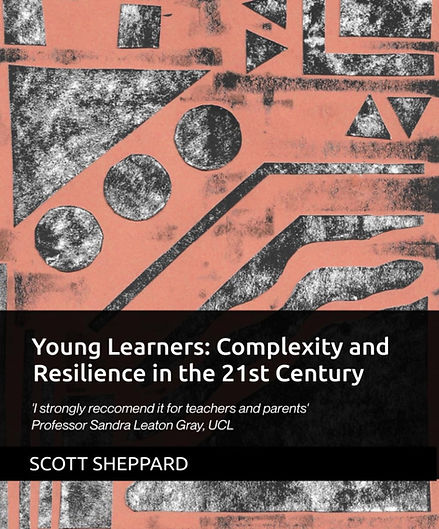
This book is rich with insight and full of practical ideas that teachers and parents can actually use. It uncovers the real forces shaping how young people learn, challenges assumptions that no longer serve us, and takes seriously the complex nature of knowledge, learning, and resilience. Most importantly, it shows what it actually takes: not in theory, but in practice, to help young people thrive at home, in school, and in the world beyond.
"Resilience isn’t just about bouncing back — it’s about understanding yourself, adapting, and growing in a world that never stops changing"
Scott Sheppard
Ready to build resilience? Download 'Deal With It' — the free, engaging game for young learners.
Join the Young Resilience newsletter and receive a free printable PDF game featured in the book. Each week, you'll get practical insights drawn from current research on how young people learn, adapt, and thrive: at home, in school, and beyond.
-
Research-led design
-
Ideal for young learners aged 7-18
-
Adaptable to any learning context
"teaching and learning are complex systems in their truest sense."
Education today exists in constant motion, shaped by complexity, tested by uncertainty, and full of possibility. Young Learners: Complexity and Resilience in the 21st Century explores learning as a dynamic system and reveals what young people actually need to flourish when the future refuses to stand still.
For teachers, parents, and homeschoolers wondering how to prepare children for a world that won't wait, this book offers a clear, evidence-based perspective. It examines the forces at work in learning environments and makes the case for resilience not as a reaction to crisis, but as the foundation for growth, adaptation, and long-term success.

"Let’s be honest, the way we talk about education often bears little resemblance to how it actually works"

Policies and traditional practices often assume that teaching and learning follow neat, linear paths: predictable inputs leading to predictable outcomes. But real education doesn't work that way. It's complex, dynamic, and deeply interconnected, shaped by countless interacting factors that rarely behave as expected.
This book challenges those oversimplified views. It reveals teaching and learning as intricate, adaptive processes that resist reduction to formula. Effective education isn't about applying templates, it's about recognising complexity, responding to it intelligently, and working with it rather than against it. The case made here is for an approach that is nuanced, flexible, and grounded in the shifting realities of a world that refuses to stay still.
"From research to real life — practical strategies for educators and parents, in the classroom and at home"
This book isn't abstract theory. Whole chapters are dedicated to practical application: classroom activities, exercises, and printable handouts, all informed by current research on complex systems, collective adaptation, and resilience. Tackling complexity doesn't mean having all the answers. It means learning how to think, adapt, and teach in a world that won't stand still.

free resources and practical learning, including downloadable PDFs, activities, and ideas for home and school


A standout feature is Deal With It, an original discussion game created by the author. Based on real scenarios from UK schools, the game turns resilience-building into an active, engaging experience for young learners. Playful yet grounded in sound pedagogy and Dialogic Teaching, it offers a practical, interactive way to help young people navigate challenge, uncertainty, and change, in the classroom, at home, or anywhere learning happens.
-
Weekly Substack email with current research and practical ideas
-
Deal With It: a free printable game to build resilience
-
Evidence-based strategies for helping young learners thrive
-
Classroom and home activities you can use immediately
-
BONUS: Every 10th subscriber receives a free PDF copy of the book
About the author
Scott Sheppard read Modern History and, as an undergraduate, worked on Oxford University's British National Corpus — an experience that sparked a lasting fascination with language and education. He went on to study teaching and education at Manchester, Sussex and University College London, and taught History for many years before becoming a writer and technologist. He has worked with organisations including Cambridge University Press, the BBC and the British Council, and is interested in children's rights, education reform and digital technology. He lives in Sussex, a little too close to the sea.